I had reached out to another researcher on Ancestry and had not heard anything back for quite some time. This past week, I heard back. This gentleman is from a collateral line and asked if I had any information to share regarding his grandparents. Actually, I had a lot to share – even further back.
It got me to thinking about how research is like eating.
 Do you eat fast, barely taking a breath, before you move on and get ready for your next meal?
Do you eat more slowly, but don’t really enjoy the meal – it is a means to an end?
Maybe you devour your meal, leaving no crumb uneaten?
Lastly, is more your style to eat and savor every single bite?
I encourage you to be somewhere between a savorer and a devourer when it comes to your research. If you do not devour every word on that document, you may miss an important piece of your ancestor’s history or personality.
Case in point:

OK, pretty basic stuff. For the research ‘inhalers’, they would put down July 2, 1891, as the marriage date of Charles Beckman and Jennie (Jane) Lloyd and the location of the marriage as Chicago, Illinois.
Maybe some will take it to the next level and calculate their years of birth (approximate), if they haven’t already done so…
…or savor this document by looking at it, in awe, that it was 122 years ago that your ancestors were married and that they applied for their license on June 13, 1891.
There’s more.
DEVOURING every piece of this document and remembering that “Google is your friend”:
Search criteria – “Howard H Russell Minister Chicago”. Not only to find out more about good ol’ Howie, but to try to verify where he was a pastor – it is not all that clear on the license.
Doing so yields several hits. The first one is the one I wanted.

From the Bentley Historical Library at the University of Michigan, a description about the man who married my ancestors:
“A leading figure of the Anti-Saloon movement, founder of the Ohio Anti-Saloon League, first general superintendent of the Anti-Saloon League of America and superintendent of the New York Anti-Saloon League. Papers include manuscript letters, speeches, diaries and miscellaneous material, and photographs. Letters include correspondence with many prominent prohibitionists and other social reformers.”
Interesting; I had no idea that they may have felt this way…
Next: Googling the “Armour Mission”, gave me surprising results:
I ended up with a link to the IIT (Illinois Institute of Technology) website.
What? Having a degree in Electrical Engineering and having been to IIT for various events, well, this was just odd to me. I had heard of the Armour Institute…could this be related?
Hmmm.
There is more information on that transformation (Click HERE), but here are two excerpts from the IIT website:
“The story of the founding of Armour Institute of Technology does not begin with the opening of its doors in September, 1893.
It goes back to a mission Sunday school in which Joseph F. Armour, a merchant of considerable means, was interested and to which he contributed liberally for its support. This mission, started in 1874, three years after the Chicago Fire, at Thirty-first and State streets, was called Plymouth Mission because it was an extension of the activities of Plymouth Church, of which Joseph F. Armour was a member.
“The mission was to be broad and wholly non-sectarian, free and open to all to the full extent of its capacity, without any restrictions whatsoever as to race, creed or class. On the first Sunday in December, 1886, seven hundred little cosmopolitans “crashed the gates” to be counted among its first members.
Among the many workers and teachers sent from Plymouth Church to assist in this experiment in practical Christian democracy, Julia A. Beveridge must be singled out for special consideration. Appointed mission librarian in 1887, she tried to stimulate an interest in reading. Soon realizing, however, that storybooks were not enough to keep idle hands and minds from mischief, she started a class in clay modeling.”
The classes started with that one clay modeling class and the rest is, well, IIT history.
What did I learn? A lot! Not only did they marry at a place that is part of Chicago history, but it is also part of MY history as well. Bonus: They also had a picture of the church.
Don’t inhale. I’m so glad that I didn’t.

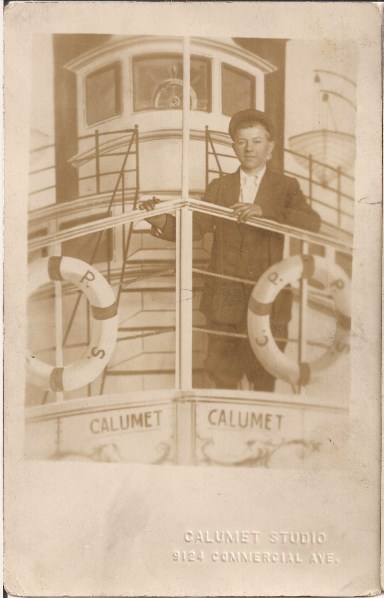 Uncle Frank is about 16 in this picture. I look at it and wonder if it was before or after he was incarcerated? Yes, I have a skeleton. It is an interesting journey. Frank spent time in various area detention facilities.
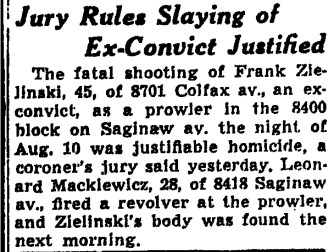 His untimely death at 44 was due to the fact that he was “friendly” with a neighbor. The


 Our Lineage

You must be logged in to post a comment.